Standing distinction
Accepted Representation, Architecture of Record and Institutional Memory are related but not equivalent.
Accepted Representation is a representation that has passed the relevant enterprise governance and acceptance process.
Architecture of Record records the standing, applicability, obligations and consequence-relevant boundaries of accepted architecture and representations.
Institutional Memory preserves accepted enterprise representation, evidence, decisions, outcomes and revisions across time for later reliance and runtime context.
AoR is therefore a governed standing record, not the whole of Institutional Memory and not a sequential runtime stage.
Architecture of Record (AoR)
Canonical parent: Enterprise Intelligence Architecture
Enterprise vocabulary: Enterprise Intelligence Architecture — Canonical Definitions
Execution-standing vocabulary: Execution Admissibility Architecture — Canonical Definitions
Web reconciliation: 11 September 2026 — P0-2I-B v1.0. Current public source linkage clarified; existing publication provenance retained.
Source baseline: Version 1.0; Publication Date 2026; original footer Last Updated 23 July 2026, retained as source-baseline history.
Further web clarification: 17 September 2026 — Acceptance attribution, representation and memory relationships, required versus operated controls, action-relative boundaries and diagnostic/adoption wording clarified. An at-a-glance explanation is added. Existing source standing, EIA parentage, definition callouts, invariant and illustrations are retained.
Source scope: AoR records accepted architectural and representation standing within Enterprise Intelligence Architecture. The execution-focused descriptions below explain its application to consequence surfaces and required controls within EAA; they do not subordinate the whole AoR construct to EAA. The retained Institutional Acceptance Surface label denotes recording of acceptance and applicability, not an independent authority that accepts representations.
Architecture of Record expands the Enterprise Intelligence Framework by recording which architecture, representations, authority boundaries and consequence surfaces have institutional standing.
In the adoption journey it provides the governed record of accepted architecture, implementation standing and consequence-relevant boundaries. It is not an independent framework and should not be read as a sequential runtime stage.
AoR records and maps where execution control is required — the points where execution can bind institutional consequence.
It maps where automated systems can bind institutional consequence, and where execution authority, context and controls must be resolved and evidenced at the relevant commit boundary.
Without an explicit Architecture of Record, organisations can struggle to maintain a reliable institutional view of where consequence-bearing execution occurs and where controls are required.
Within the Enterprise Intelligence transformation journey, Architecture of Record explains how the enterprise records accepted architecture, implementation standing and consequence-relevant boundaries as insertion and implementation choices are governed over time.
This is an adoption and reading path, not a compulsory one-pass delivery order or runtime pipeline. Diagnostic findings can inform an initial AoR and later refinement; a diagnostic does not itself confer acceptance or prove that required controls operate.
Enterprise Intelligence Assessment
↓
Enterprise Insertion Patterns
↓
Enterprise Implementation Patterns
↓
Architecture of Record
↓
Pre-Execution Pressure Test
↓
SCIA Runtime Reference Architecture
The Architecture of Record records the standing of accepted architecture and its implementation-relevant boundaries. It records which representations, authority boundaries and consequence surfaces have institutional standing after architectural responsibilities have been translated into implementation choices.
Why this matters
System maps, data models and decision-governance records do not necessarily identify the operations at which institutional consequence binds. AoR makes those accepted relationships, authority boundaries and required control points explicit for a declared scope.
Where the record is incomplete, the enterprise may lack evidence that every relevant consequence boundary and control obligation has been identified. This indicates a mapping and evidence gap; it does not prove that no operational controls exist.
🔗 Core Links
- Enterprise Intelligence Architecture — current public capstone architecture
- Execution Admissibility Architecture
- Enterprise Insertion Patterns
- SCIA Runtime Reference Architecture
- Authority Pressure Test
- Architecture
- Execution Admissibility Architecture — Canonical Definitions
Definition
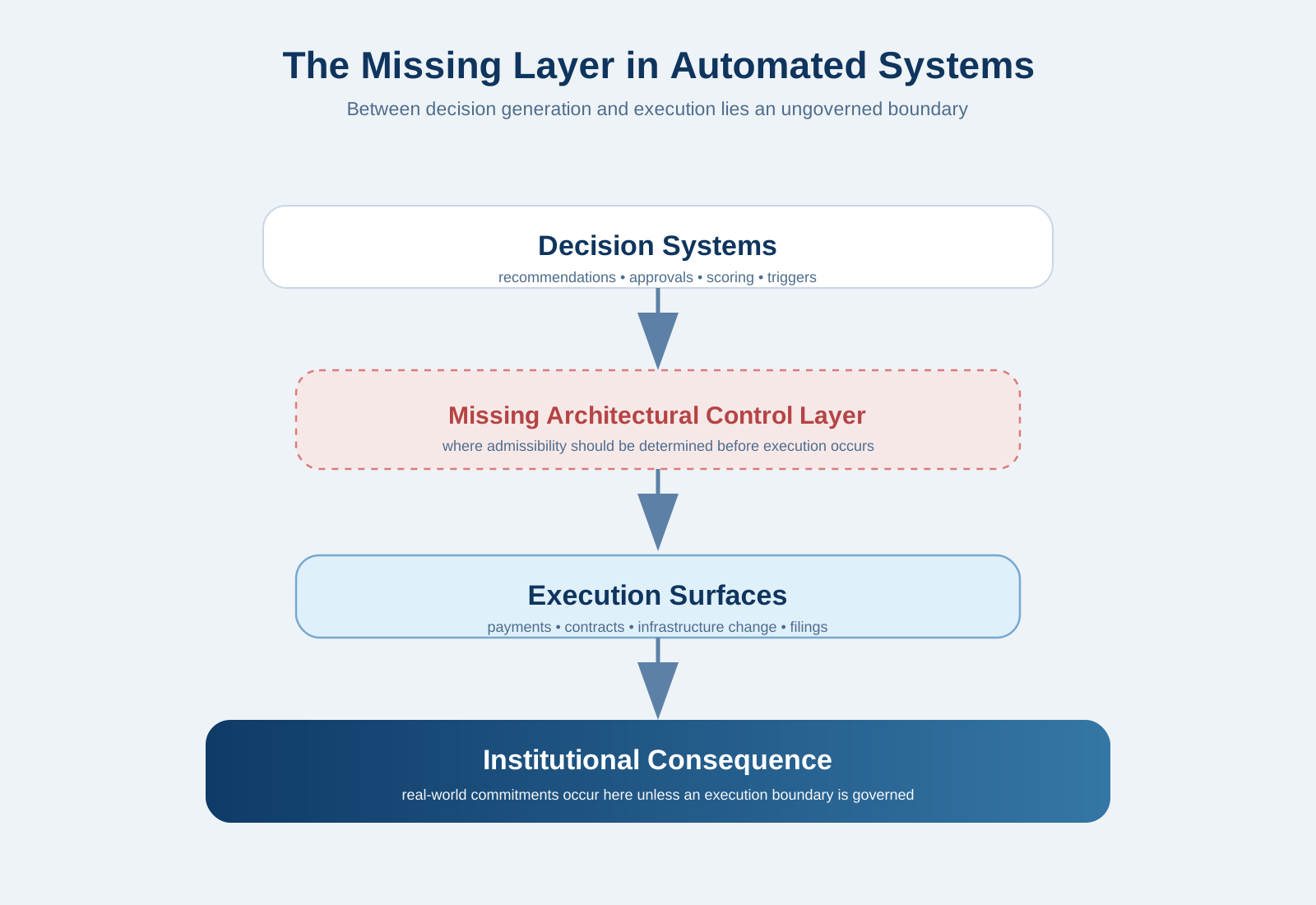
Architecture of Record (AoR) is the governed enterprise architecture record that identifies accepted architectural standing and maps the execution surfaces where automated systems can bind institutional consequence.
It identifies the systems, authority boundaries, and control points through which automated actions commit financial, legal, operational, or regulatory outcomes.
By making the institutional consequence topology explicit, AoR identifies where Execution Admissibility controls need to be applied.
AoR provides the structural foundation for implementing Execution Admissibility Architecture.
Execution authority is not inherent in an automated action. It must be resolved and evidenced at the relevant point where automated systems can bind institutional consequence. The Architecture of Record identifies where that resolution is required.
Architecture of Record functions as the enterprise commit map — the structural topology that defines where automated systems bind institutional consequence.
It is also the institutional record of which enterprise representations possess accepted institutional standing.
The Architecture of Record does not create representations.
AoR records the standing and applicability of enterprise representations; it does not replace the enterprise governance process that accepts them. Enterprise Representation Intelligence forms and evolves representations, and Source-Aligned Data Products can supply governed projections that preserve operational fidelity. Publication establishes participation separately; neither projection nor recording confers institutional acceptance by itself.
Architecture of Record records which representations have acquired accepted institutional standing through the enterprise's governance and acceptance processes.
It records the standing, applicability and relevant reliance boundaries of accepted representations.
It provides the governed map of where execution authority and execution controls must be resolved within the enterprise.
Enterprise Insertion Patterns use this institutional standing to identify where Enterprise Intelligence reconnects with operational execution before irreversible consequence occurs.
Intelligence may propose. Architecture identifies the boundaries and responsibilities within which execution must be governed; admissibility and institutional authority determine whether a proposed action may proceed.
Every Arqua architecture must be coherent, explainable, relational, semantic, governed, resilient, elegant, and execution-admissible.
Purpose
AoR exists because authority is not inherent in automated execution and must remain explicit, governable and reconstructable.
It provides the structural map of where automated systems can create institutional consequence by mutating enterprise state.
This architecture enables organisations to govern execution and maintain accountability as AI and automation scale.
Scope
AoR applies to enterprise systems where automated execution can bind consequence, including systems that control:
- financial transactions
- contract activation
- capital commitment
- infrastructure mutation
- regulatory reporting
AoR focuses on execution surfaces and authority boundaries.
It does not replace application architecture, data architecture, or integration architecture.
IP boundary
Arqua does not transfer its proprietary internal framework.
Client engagements may produce client-specific Architecture of Record artefacts derived from the Arqua architecture.
The Automation Governance Gap
Modern enterprises increasingly rely on automated systems, AI, and software workflows to execute payments, contract activation, infrastructure changes, and regulatory filings.
Mapping systems, applications, data flows and integrations does not by itself establish where a particular action binds consequence. This reference addresses the execution-standing gap that arises when those boundaries and their applicable authority are not explicit.
The extent of any gap must be assessed against the organisation's existing records, operating flows and evidence. AoR does not presume that every organisation lacks consequence mapping or that adopting this terminology creates effective control.
Architectural Model
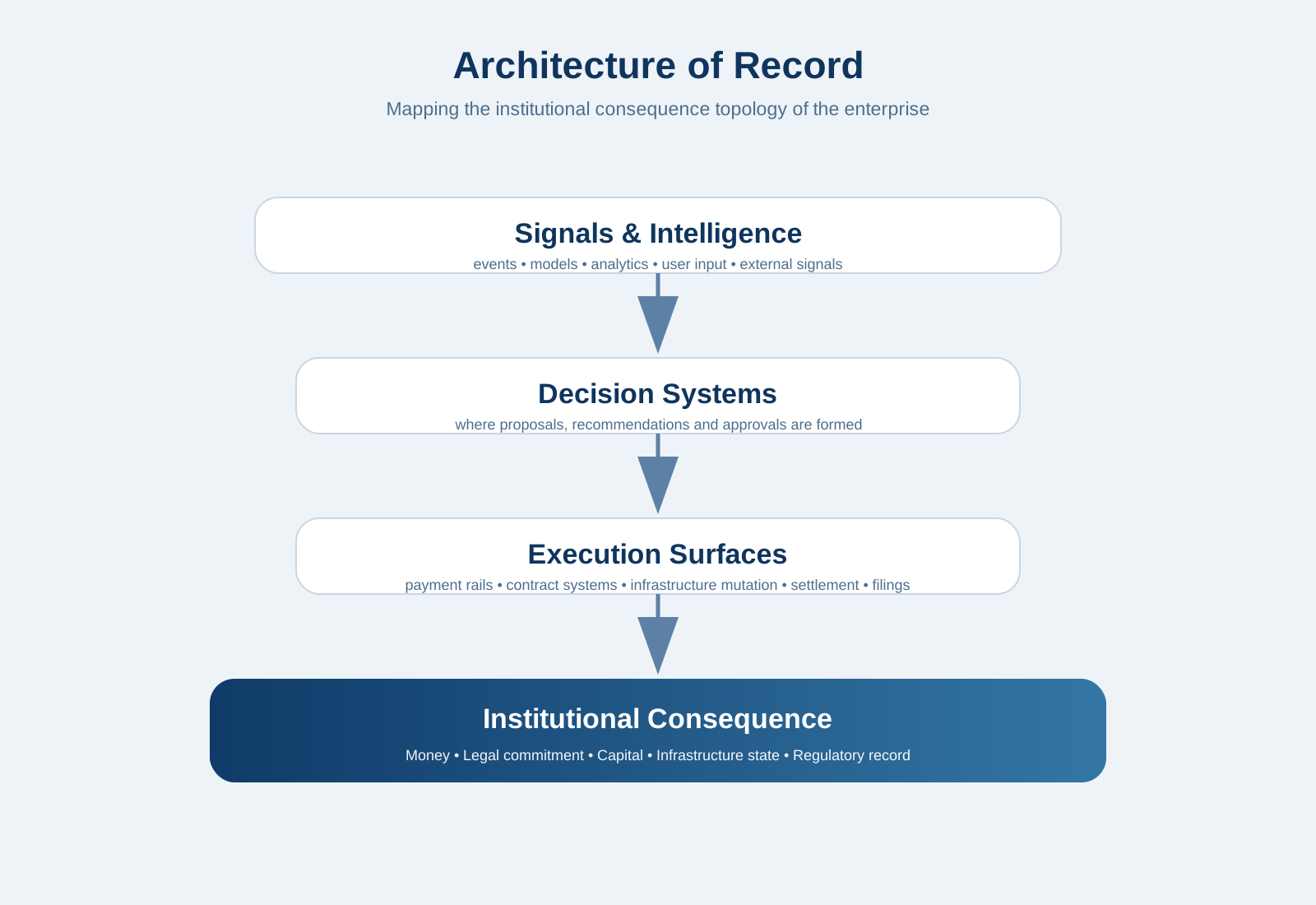
AoR maps the path from signal to consequence.
It identifies where automated execution must be governed.
Signals and Intelligence
Events, analytics, models, and inputs that inform decisions.
Decision Systems
Systems that generate proposals, approvals, or candidate actions.
Execution Surfaces
Systems where execution binds institutional consequence by mutating state.
Institutional Consequence
Financial, legal, operational, or regulatory outcomes.
Core Structural Elements
AoR identifies four key structural elements that define where automated execution must be governed.
Execution Surfaces
Systems where automated execution can bind institutional consequence.
Consequence Systems
Systems responsible for financial, legal, infrastructure, or regulatory commitments.
Authority Boundaries
Actors, systems, or processes authorised to trigger consequence-bearing state transitions.
Admissibility Control Points
Non-bypassable checkpoints where admissibility must be re-resolved before consequence binds.
Non-bypassability is a requirement to realise and test, not a property established merely by drawing or recording the control point. The map must distinguish required controls from evidence of their implementation and operation. The relevant boundary belongs to the particular consequence-bearing operation; an approval, publication or coordination step that itself binds consequence is not exempt because of its label.
Institutional Consequence Topology
Institutional consequence occurs when execution results in:
- movement of money
- activation of contracts
- commitment of capital
- mutation of infrastructure
- creation of regulatory records
These execution surfaces define the institutional consequence topology of the enterprise.
The Architecture of Record identifies where authority becomes consequential.
Authority Lifecycle Integrity evaluates whether authority remained structurally coherent before reaching those consequence-bearing surfaces.
Relationship to Execution Admissibility Architecture
AoR's execution-standing view supplies the governed map of consequence surfaces, authority boundaries and required control points used to implement Execution Admissibility Architecture. Applicable authority, context, constraints, state and evidence must be resolved at the relevant boundary; the map does not create that authority or establish that enforcement has been implemented.
Enterprise Insertion Patterns identify the constitutional operational boundary at which those accepted representations reconnect with operational execution. They do not replace AoR. AoR supplies recorded standing and consequence topology; insertion patterns identify where operational execution resumes.
This preserves the governing separation:
- Decision (what could happen)
- Admissibility (what is allowed to happen, re-resolved at execution)
- Execution (what actually happens)
Relationship to System Model Foundation and Institutional Memory
Representation: System Model Foundation supplies structures through which operational reality can be represented. Source-Aligned Data Products may expose governed representation projections that preserve source meaning and operational fidelity. Enterprise Representation Intelligence forms and evolves representations and supports their evaluation. SMF is a representational foundation, not an output of publication.
Acceptance and recording: The appropriate enterprise governance process accepts or reaccepts representations for a declared scope and purpose. Architecture of Record records that standing, its acceptance basis, applicability, obligations and consequence-relevant boundaries. A proposed or validated representation does not acquire acceptance merely by being stored in an architectural record.
Preservation and participation: Institutional Memory preserves accepted understanding and associated evidence, decisions and revision history. Enterprise Product Publication separately establishes governed participation under the appropriate authority. AoR recording, memory preservation and publication are related responsibilities, not mandatory consecutive stages for every representation.
Use and consequence: Runtime Context Assembly forms and qualifies understanding for a declared Intent Scope from eligible Published Enterprise Products. Recorded acceptance and qualified understanding do not authorise execution. AoR's execution-standing view identifies where the separate execution-admissibility controls are required.
Change and evidence: Recorded standing must remain linked to scope, version, acceptance basis and applicable conditions. Proposed amendments remain distinguishable from accepted revisions, and later corrections preserve prior records and evidence. Updating an obligation in AoR does not prove that implementations or consumers have adopted the change; implementation and runtime evidence must establish that effect.
Upstream Recommendation Pathways
Recommendation Integrity can identify recommendation pathways that may later become execution surfaces.
Where a recommendation moves toward consequence-bearing action — such as approval, contract, payment, procurement, work order, capital release, lease execution, acquisition, or divestment — it may become a candidate for Architecture of Record mapping.
The Architecture of Record remains focused on execution surfaces where actions bind institutional consequence. Recommendation Integrity helps identify which upstream recommendations may require that mapping.
Where Execution Passports are required
Architecture of Record identifies where institutional consequence binds and where execution control must exist. In AI-mediated or automated workflows, AoR also identifies where an Execution Passport must be presented for validation before action is allowed to cross the commit boundary.
The Execution Passport does not replace AoR. AoR maps the execution surfaces, authority boundaries, and admissibility control points. The passport carries the authority-state claim for a proposed action. SCIA Runtime validates that claim at T=0.
Related paper: The Desynchronization of Authority
The passport references here describe the existing architectural requirement, not evidence that a passport, validation service or enforcement control has been implemented for a particular action. Mapping its required use does not issue the artefact, validate its claims or grant execution permission. The linked specification retains its own scope and disclosure requirements.
AoR records where controls are required. SCIA Runtime supplies the runtime reference architecture for Execution Admissibility within EAA; implementation and operation remain with the organisation and its delivery partners. The reference is not itself a deployed enforcement service or the operational executor.
The applicable implementation must evaluate the proposed consequence-bearing action at its commit boundary and evidence the resulting determination and conditions. Recording the boundary in AoR, or citing SCIA Runtime, does not establish that this evaluation occurred.
SCIA Runtime addresses consequence-bearing state transitions; an earlier decision does not by itself establish that the later execution may proceed. The architectural invariant remains:
No state transition without proven integrity.
This is a requirement on the implementation, not a guarantee established by the existence of this architecture page. Required control, implemented control, actual operation and observed outcome remain separately evidenced.
How AoR is created
AoR is not produced from documentation alone.
The Pre-Execution Pressure Test can support creation or refinement of AoR by examining a declared consequence-bearing flow.
Within that diagnostic scope, findings may identify execution surfaces and evidence gaps, expose implicit authority assumptions, and inform an initial or revised consequence map. The enterprise's accountable architecture and governance process determines the record's acceptance and applicable standing. A diagnostic finding is not an execution permission, an accepted representation by default or proof of complete enterprise coverage.
Next step
Start with one high-consequence decision.
Journey: Enterprise Intelligence Assessment → Enterprise Insertion Patterns → Enterprise Implementation Patterns → Architecture of Record → Pre-Execution Pressure Test → SCIA Runtime Reference Architecture
Architecture of Record Engagement
Most organisations develop their AoR through a structured engagement focused on:
- mapping execution surfaces
- identifying consequence systems
- defining authority boundaries
- establishing admissibility control points
- producing the institutional consequence topology of the enterprise
Deliverables
- mapped execution topology
- identified execution surfaces and consequence systems
- authority boundary definitions
- admissibility control points
- architectural recommendations for implementing Execution Admissibility Architecture
Next Steps
- Execution Admissibility Architecture
- The architectural discipline governing admissible execution.
- SCIA Runtime Reference Architecture
- The runtime architecture that governs state transitions through integrity at execution.
- Execution Admissibility Architecture — Architecture Map
- Layered map of the execution admissibility stack.
- Authority Pressure Test
- Diagnostic that identifies uncontrolled execution surfaces.
Final insight
Explicitly mapping where consequence binds makes control obligations and evidence gaps examinable. Confidence in actual control still depends on what the organisation has implemented and observed for the declared scope.
Document Status: Public Architecture Paper
Publication Date: 2026
Version: 1.0
Last Updated: 17 September 2026
Permanent URL: https://app.notion.com/p/31e09430b23c4437ab665bef388279ab
Owner: Arqua Pty Ltd
Author: Mark Tovey
Portfolio: Enterprise Intelligence Architecture
Constitutional Category: Institutional Acceptance Surface
This paper forms part of the Arqua Constitutional Architecture of Enterprise Intelligence. It should be read together with the related constitutional papers referenced throughout this portfolio.
© 2025–Present Arqua Pty Ltd. All rights reserved.
This publication forms part of the Arqua Enterprise Intelligence Architecture portfolio.
No part of this publication may be reproduced, redistributed, adapted, republished or incorporated into derivative works without the prior written permission of Arqua Pty Ltd, except for brief quotations used with appropriate attribution.
The concepts, architectural models, constitutional frameworks, terminology and diagrams presented on this page constitute original intellectual property developed by Arqua Pty Ltd.
Publication of this material does not grant any licence to implement, commercialise or reproduce the underlying intellectual property.
Arqua®, SCIA™, Enterprise Intelligence Architecture™, Runtime Context Assembly™, Enterprise Representation Intelligence™, Institutional Memory™, Execution Admissibility™, Pre-Execution Pressure Test™, and associated architectural terminology may be trademarks, registered trademarks or protected intellectual property of Arqua Pty Ltd.
This publication may be read, cited and discussed. Automated extraction, republication, model training or commercial reuse of substantial portions of this work without written permission from Arqua Pty Ltd is prohibited except where required by applicable law.