
Explore the architecture behind Enterprise Intelligence
Enterprise Intelligence Architecture connects operational reality with representation, meaning, memory, purpose-specific runtime understanding, coordinated action, consequence and learning. It makes the responsibilities and boundaries between these concerns explicit so that institutional understanding can remain coherent as conditions change.
New to the subject? Start with Enterprise Intelligence.
Ask the Arqua Guide — explore the approved public architecture through questions and examples.
Explore technologies and implementation
- Technology Participation in Enterprise Intelligence — browse technologies by architectural contribution.
- Implementation — explore implementation patterns and platform realisations.
Start here
- Enterprise Intelligence Architecture — the designated public capstone and integrated reference architecture.
- Enterprise Intelligence Architecture — Canonical Definitions — the enterprise-wide canonical vocabulary.
- Enterprise Intelligence Framework — the explanatory introduction and reading path.
How to read these sources
Use Enterprise Intelligence Architecture — Canonical Definitions for enterprise-wide definitions and Enterprise Intelligence Architecture for the integrated architecture and its relationships. Detailed references explain responsibilities within their declared scope; domain-specific vocabulary inherits from the enterprise vocabulary. The Framework and gateway pages provide explanations and reading paths.
Check each source’s stated scope, version and publication standing. If two explanations appear inconsistent, identify the conflicting passages and their source standing for reconciliation. Do not silently merge them or assume that a newer or more detailed page automatically supersedes another source.
Explore by architectural concern
The groups below are editorial navigation. They are not canonical architectural layers, a deployment model, runtime stages or a mandatory reading sequence.
Represent operational reality
- System Model Foundation — defines the structural basis through which operational reality can be represented consistently.
- Enterprise Representation Intelligence — forms, evaluates and evolves enterprise representations. It supports governed acceptance; the applicable enterprise governance process confers standing.
Record standing and preserve continuity
- Architecture of Record (AoR) — the current public reference for recording standing, applicability, obligations and consequence-relevant boundaries.
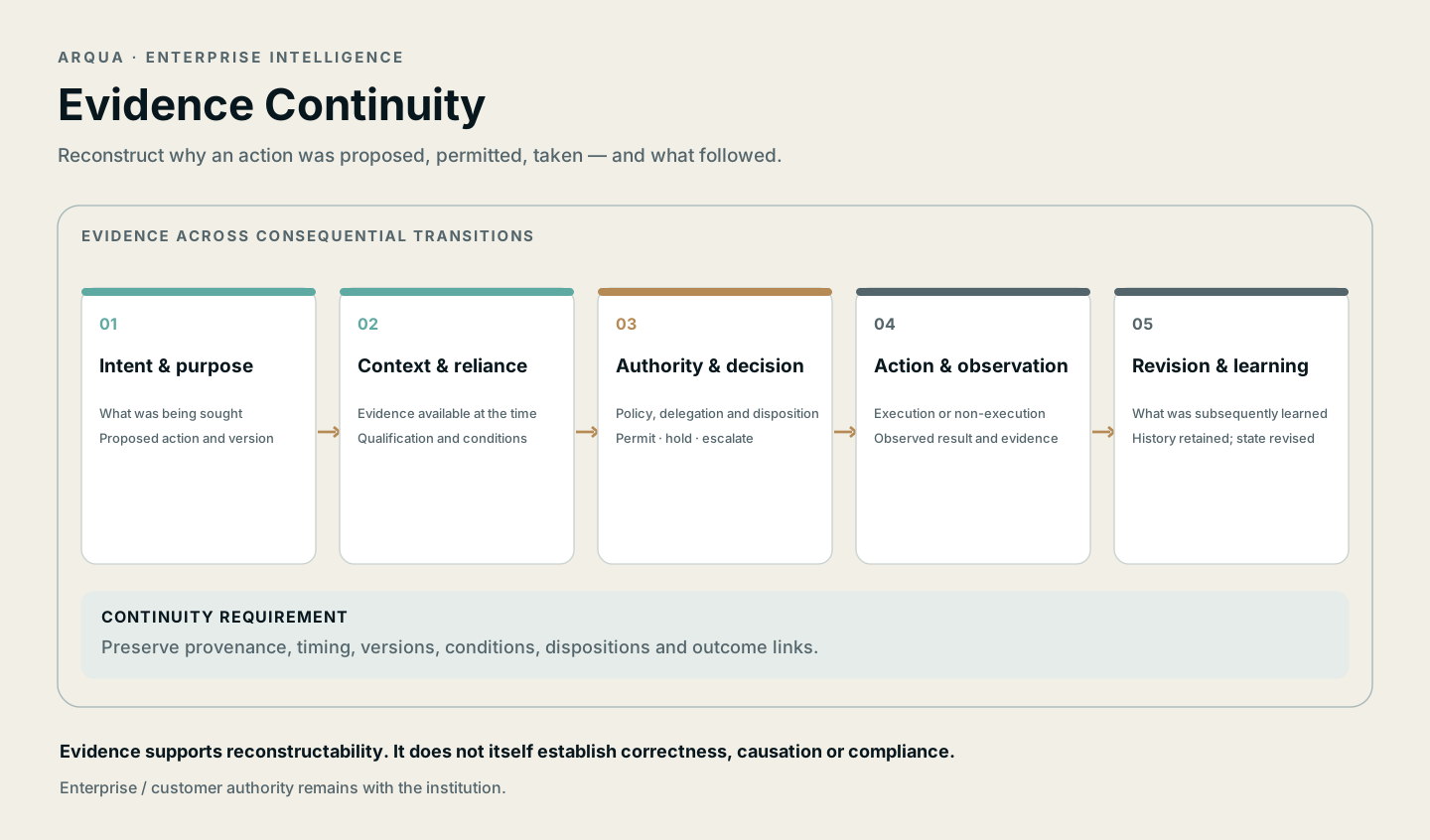
- Institutional Memory — the current public explanatory reference for preserving accepted understanding, evidence, decisions, outcomes and revision history across time. It is not presented here as a newly published formal paper.
Form understanding for a purpose
- Runtime Context Assembly — forms Candidate Operational Understanding from governed Published Enterprise Products and qualifies it for a declared Operational Intent. Qualified Operational Understanding results only where reliance is supported; qualification does not authorise execution.
Govern across the architecture
- The Enterprise Control Plane — provides cross-cutting governance across architectural responsibilities. It is not an additional sequential processing stage.
Govern consequence-bearing execution
- Execution Admissibility Architecture — governs whether proposed consequence-bearing execution may proceed against applicable enterprise conditions.
- SCIA Runtime Reference Architecture — the current runtime reference architecture within Execution Admissibility Architecture, not a later or separate admissibility gate.
- Execution Admissibility Architecture — Canonical Definitions — the domain-specific vocabulary for consequence-boundary concepts. It inherits from, and does not replace, the enterprise-wide vocabulary.
Explore implementation and technology participation
Implementation explains how the established architecture can be realised through technology-independent patterns, platform capabilities and evidence-grounded vendor interpretations.
Technology Participation in Enterprise Intelligence examines what named technologies may contribute, under which conditions, and which responsibilities remain with the enterprise. These assessments are not vendor certifications or implementation recommendations.
Recognise recurring authority conditions
Authority Pattern Library connects cross-sector patterns with bounded operating contexts. It is an explanatory reading path, not a diagnostic verdict, canonical architecture layer or implementation requirement.
Read beyond these entry points
The capstone architecture also addresses accepted meaning, publication and participation, semantic continuity, enterprise coordination, operational consequence, outcome evidence and governed representation evolution.
Use Architecture Papers to explore supporting specifications, reference architectures, patterns and applied concerns while retaining each source's declared standing and provenance.
Current architecture insight
- When AI Agents Remember and Act: The Architecture of Persistent Delegation — explains the control problem created when agents retain context, operate across time and increasingly act across connected services. It is an explanatory architecture insight, not canonical architecture or implementation evidence.
Connect with existing architecture and governance
Enterprise Bridges explains how Arqua relates to established enterprise architecture, governance and operating practices while preserving their distinct responsibilities.
Apply and interoperate
- Profiles — Applying Arqua Architecture to a Defined Context — explains how stable Arqua architecture is projected onto a particular product, technology, customer, authority, sector or interoperability context without rewriting the source architecture.
- Interoperability — Work With Your Existing Environment — explains how customers, partners and technology providers can participate while retaining their own systems, semantics and authority.
- Codex Commons remains a separately governed semantic-interoperability publication through the Codex Resonance website; Arqua may reference or consume eligible Commons semantics without republishing them or transferring Commons standing into Arqua.
Architecture and implementation
Technology can realise architectural responsibilities, but it does not define the architecture. Platforms, products, data services, semantic technologies, AI models and agents may implement or support selected responsibilities without becoming Enterprise Intelligence Architecture.
A reference architecture describes responsibilities and relationships. Its publication or adoption does not prove that a particular implementation conforms, operates correctly or provides legal, regulatory or operational assurance.
This page is an explanatory architecture gateway. The linked canonical vocabulary, capstone and reference sources retain their respective authority and publication standing.
© 2025–Present Arqua Pty Ltd. All rights reserved.
This publication forms part of the Arqua Enterprise Intelligence Architecture portfolio.
No part of this publication may be reproduced, redistributed, adapted, republished or incorporated into derivative works without the prior written permission of Arqua Pty Ltd, except for brief quotations used with appropriate attribution.
The concepts, architectural models, architectural frameworks, terminology and diagrams presented on this page constitute original intellectual property developed by Arqua Pty Ltd.
Publication of this material does not grant any licence to implement, commercialise or reproduce the underlying intellectual property.
Arqua®, SCIA™, Enterprise Intelligence Architecture™, Runtime Context Assembly™, Enterprise Representation Intelligence™, Institutional Memory™, Execution Admissibility™, Pre-Execution Pressure Test™, Authority Pressure Test™, and associated architectural terminology may be trademarks, registered trademarks or protected intellectual property of Arqua Pty Ltd.
Execution Admissibility ArchitectureExecution-Bound EnterpriseArchitecture of Record (AoR)SCIA Runtime Reference ArchitectureExecution Admissibility Architecture — Architecture MapCoherence-Bound EnterpriseHow It WorksAuthority Lifecycle IntegrityWhen AI Agents Remember and Act: The Architecture of Persistent DelegationProfiles — Applying Arqua Architecture to a Defined Context