
Start with one important business problem
Arqua helps organisations resolve differences in what teams, systems and AI understand, what evidence they rely on and who is responsible for decisions and actions. Start with a real customer pain point, workflow or decision you need to move forward.
An initial briefing helps identify whether Discover is a useful next step. Where you already have a defined strategy or architecture need, we can discuss the appropriate advisory scope directly.
Start with a briefing
Use Request a Briefing to begin an architecture-focused discussion. The briefing is consultative and does not involve system access, data analysis, platform selection or operational change. Any next step depends on what the discussion establishes.
Arqua Discover — start with one important decision
Get a clear basis for deciding what to do next—including no further work with Arqua.
When your teams, systems or AI use the same information differently, Arqua Discover identifies where meaning diverges, which decisions need an accountable owner and what must be checked before implementation or automation.
A bounded assessment of one consequential workflow across two or three representations leads to three practical outputs you can review with your delivery team:
- A meaning and alignment map — the source meanings, conflicts, qualified mappings and outstanding questions.
- A requirements and responsibility map — what needs resolving, what existing capabilities can support and who must decide.
- An evidence and decision brief — supported findings, limitations and prioritised next-step choices, including no further work with Arqua.
Each output retains qualified findings and outstanding questions instead of inventing agreement. Begin with a briefing to check the problem, evidence access and sponsor. Scope, delivery timing, fees and customer-use rights are agreed before an engagement begins.
After Discover — Design where further work is useful
Where further work is justified and separately agreed, Design translates the findings into selected models, applicable Profiles, semantic or technical contracts, mappings, implementation responsibilities, acceptance tests and change requirements.
Profiles — Applying Arqua Architecture to a Defined Context defines which architectural responsibilities apply to the particular subject, purpose and scope. Interoperability — Work With Your Existing Environment explains how existing customer, vendor and partner capabilities can work together to realise them.
The outcome is a versioned specification and handoff for the appointed delivery team. Implementation, evaluation and any later revalidation are separately scoped where needed. Customers retain their meaning, acceptance decisions and operational authority. There is no mandatory follow-on engagement, new platform or licence.
Specialist advisory and diagnostics
If you already know the support you need, discuss Architecture Advisory for strategy and architecture guidance, Enterprise Intelligence Assessment for a broader diagnostic, or Pre-Execution Pressure Test for the evidence and conditions surrounding a specific proposed action. Scope and outputs are agreed for your situation; a briefing helps identify the appropriate route.
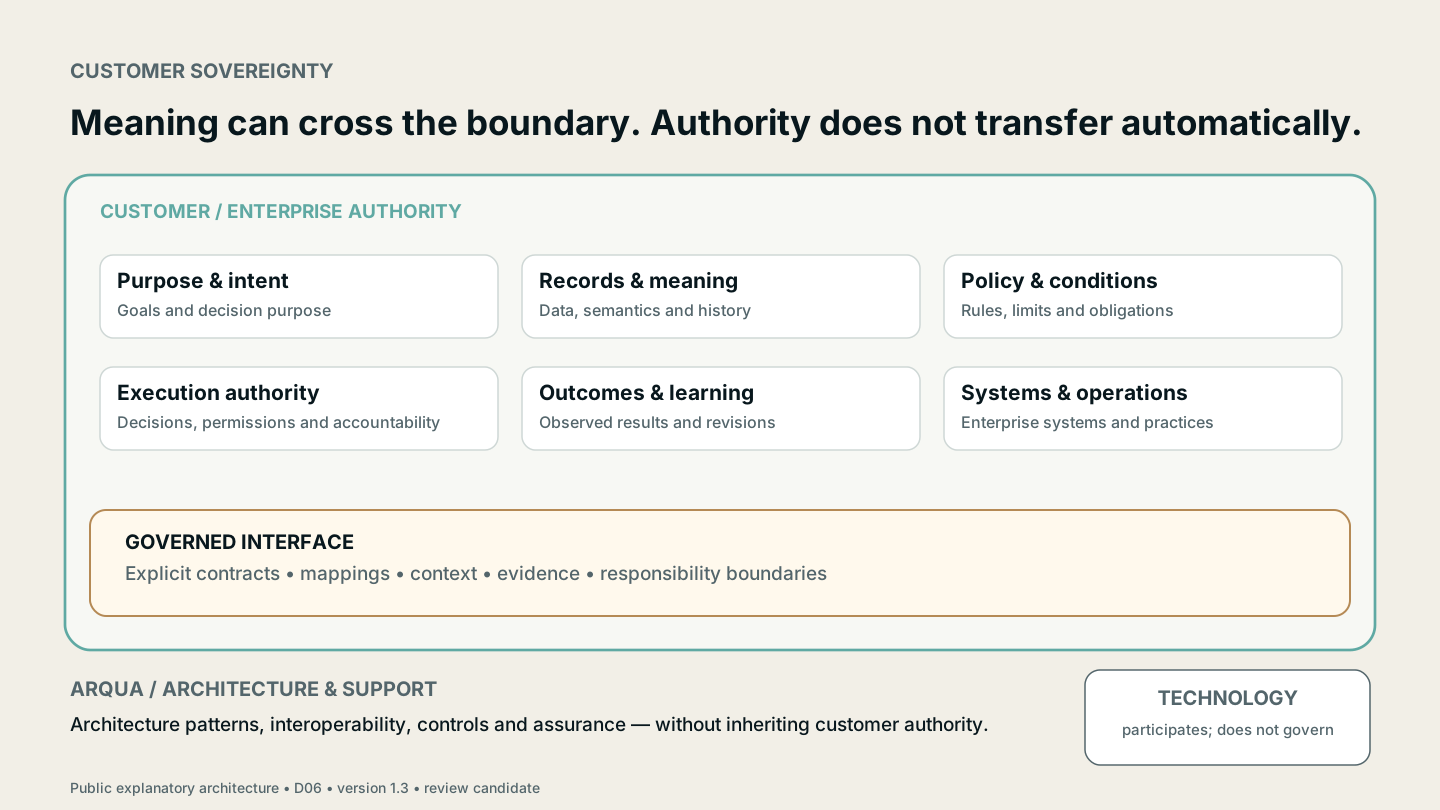
Work with your existing environment
Arqua does not assume that a customer must replace existing platforms or adopt one central Arqua runtime.
Interoperability — Work With Your Existing Environment explains the current public participation model: Arqua defines responsibilities and Profiles; customer and vendor capabilities may participate through explicit mappings and evidence; customer authority remains external.
Profiles — Applying Arqua Architecture to a Defined Context explains how applicability is bounded for a defined subject and purpose.
Bring a real situation
Tell us about your situation Briefly describe the situation you would like to explore with Arqua. Please include only information you are authorised to share, and do not include confidential or sensitive material. Submitting an enquiry does not establish an engagement.
A useful conversation begins with the outcome you are trying to achieve and one consequence-bearing action where that outcome becomes real. From there, Arqua can determine what architecture, context, evidence, authority and controls are relevant.
A useful conversation can begin with a specific operational concern:
- an AI-assisted recommendation approaching approval or execution;
- a workflow in which authority or accountability is unclear;
- an enterprise representation, graph or model that must remain aligned with evidence;
- fragmented institutional memory or inconsistent runtime context;
- an architecture, programme or operating model moving toward consequential delivery.
Arqua helps clarify the architectural question, identify the relevant boundary and determine whether a further engagement is appropriate. Decisions, implementation, execution, operations, compliance and outcomes remain the responsibility of the organisation and its delivery partners.
Arqua provides architecture advisory and scoped assessments. Implementation and operation are separately agreed where applicable; customer decisions and authority remain with your organisation.
Explore before starting
- Enterprise Intelligence — an introduction to the category and its current source routes.
- Architecture — the current architectural references and reading paths.
- Applications — bounded illustrations of operational situations.
- Research — publications and research in their original standing.
- The Arqua Guide — questions and explanations grounded in the approved public corpus.
Next step
Start with the intended outcome and the specific consequential action, decision or commitment where it matters. Request a Briefing provides the current entry point for determining whether—and where—Arqua may be able to help.
Each engagement has an agreed scope, deliverables and customer-use rights. Linked architectural material retains its stated scope and intellectual-property terms.
Interoperability — Work With Your Existing Environment