
From operational reality to governed action and revised representation
An enterprise needs more than information and reasoning. It needs to keep what it understands connected to what it decides, how it acts and what it learns.
In Arqua, Enterprise Intelligence is the institutional capability to maintain coherent understanding, legitimate authority and coordinated action as operating conditions change. Enterprise Intelligence Architecture describes the responsibilities and relationships that support that capability.
Architecture · Enterprise Intelligence Framework · Ask the Arqua Guide
Why more information is not enough
An organisation can have systems of record, data platforms, semantic layers, AI models, agents and automated workflows without a coherent connection between them.
A representation may be available without its meaning being accepted. Accepted understanding may be retained without being suitable for a particular purpose. A decision may be approved without establishing that a proposed action can proceed when consequence is about to bind.
Enterprise Intelligence Architecture addresses these connections. It asks what was represented, which meaning was accepted, who relied upon it, what authority applied, what action occurred and how its outcome changed future understanding.
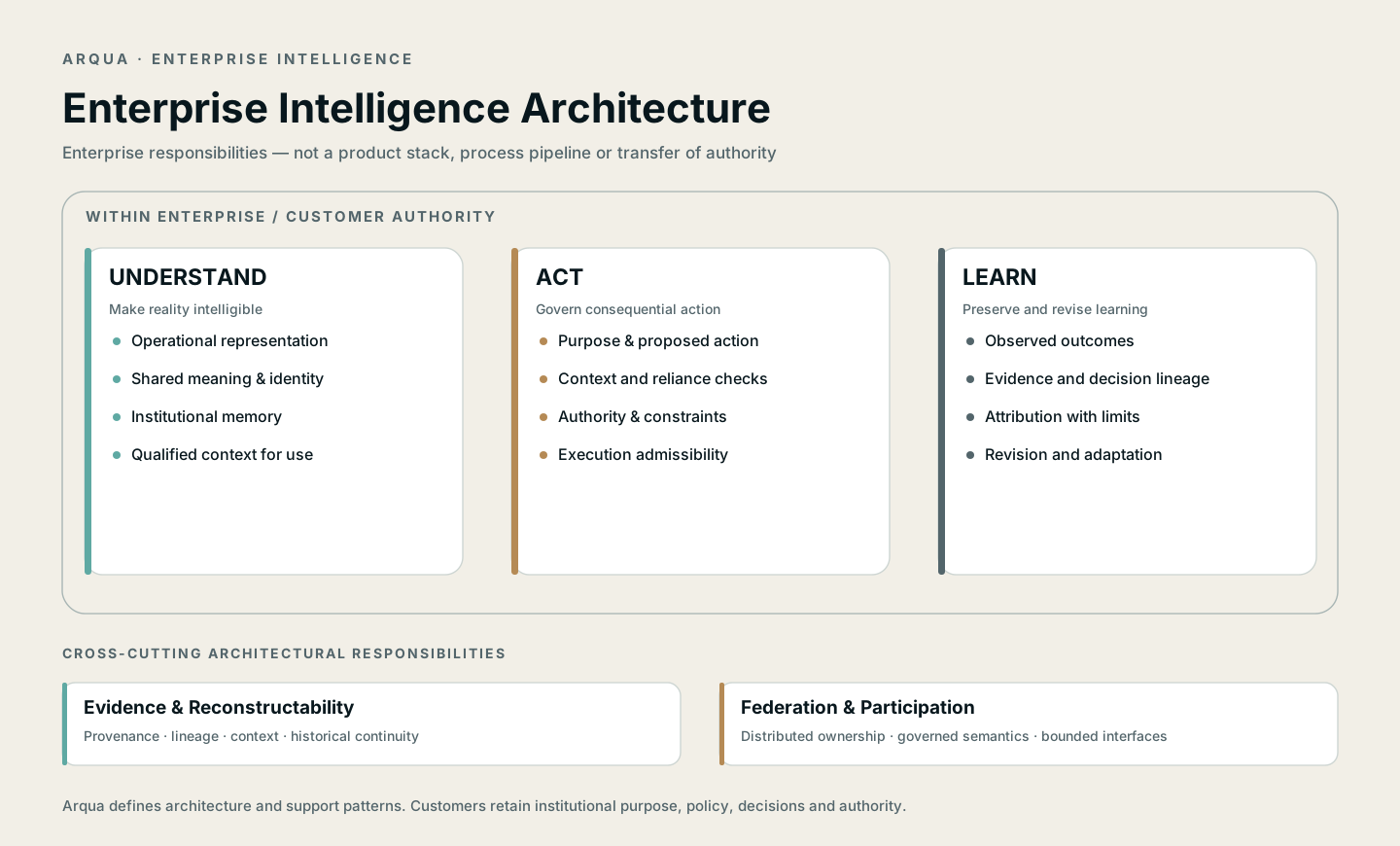
What the architecture connects
Representation and accepted understanding
The System Model Foundation provides a structural basis for representing operational reality. Enterprise Representation Intelligence forms and evolves those representations and supports their evaluation. The appropriate enterprise governance process determines which representations acquire accepted standing for a declared scope and purpose.
Standing and continuity
Architecture of Record records accepted architectural and representation standing, applicability, obligations and consequence-relevant boundaries. Institutional Memory preserves accepted understanding together with its evidence, decisions, outcomes and revision history.
They serve different responsibilities. Recording standing is not the same as preserving understanding through time. The defining characteristic of Institutional Memory is continuity, not storage.
Purpose-specific operational understanding
Runtime Context Assembly forms and qualifies understanding for a defined Operational Intent, using governed Published Enterprise Products. Context formation produces a candidate; Context Qualification evaluates whether it supports reliance for the intended use.
Qualified Operational Understanding results where reliance is supported. Qualification does not itself create authority or permission to execute.
Coordinated action and learning
Qualified understanding can support people, systems, workflows and agents in coordinating action. Execution Admissibility separately evaluates proposed consequence-bearing execution against the applicable enterprise conditions.
Outcomes provide evidence for learning. Changes to accepted representation pass through governed revision and reacceptance, preserving the history needed to reconstruct earlier understanding.
The Enterprise Control Plane provides cross-cutting governance across these responsibilities. It is not another sequential processing stage.
More than business intelligence or an AI platform
Business intelligence helps an enterprise observe, analyse and report. Enterprise Intelligence Architecture extends the concern to how representation, meaning, reliance, authority, action, consequence and learning remain connected.
Data platforms, semantic technologies, AI models and agents may implement or support parts of this architecture. None defines the complete institutional responsibility on its own. The architecture is not a substitute for organisational accountability.
Start with one consequential decision
Choose one decision or operational action. Trace the understanding it uses, the purpose for which that understanding is relied upon, the authority and conditions relevant to execution, and the evidence of what happened afterwards.
That provides a starting point for exploring where the responsibilities are already explicit and where connections remain incomplete. It is not, by itself, a determination that a workflow is admissible.
Explore through conversation
The Arqua Enterprise Intelligence Guide helps you explore the approved public architecture through questions and examples. Its responses are explanations of the source corpus, not a separate source of architectural authority.
Continue exploring
- Enterprise Intelligence Framework — an introduction and reading path through the portfolio.
- Enterprise Intelligence Architecture — the integrated capstone reference architecture.
- Enterprise Intelligence Architecture — Canonical Definitions — the enterprise vocabulary for the architecture.
- Architecture — the gateway to canonical architecture, public reference architectures and supporting sources.
This page is an introductory explanation and navigation gateway. The linked architecture and vocabulary sources retain their respective authority and publication standing.